
Student Spotlight: Olivia Fichera






Student Spotlight: Olivia Fichera
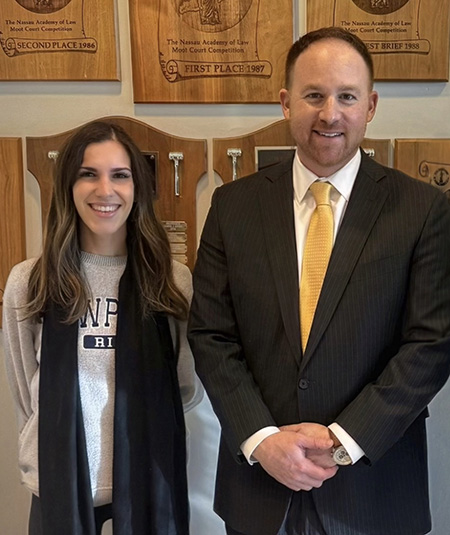 Olivia Fichera is a determined 3L whose journey to Touro Law began with uncertainty but has blossomed into a purposeful path. Olivia discovered her passion for law through a college business law course that changed her trajectory. Now, as she approaches graduation, her transformative experience in the Criminal Prosecution Clinic has not only confirmed her courtroom aspirations but reshaped her understanding of the criminal justice system. From hesitant participant to passionate advocate, Olivia's story is one of growth, intentionality, and the power of saying yes to opportunities that push us beyond our comfort zones.
Why did you decide to go to law school? Why Touro Law?
My path to law school wasn’t a straight line. Growing up, I constantly heard comments like “you should be a lawyer,” and, if I’m being honest, that alone made me want to do the opposite. When I started college at St. John’s University, I chose a business major and assumed that was the direction I’d take. After being placed in a business law course my first semester, my interest in the field was piqued, and as a result, I decided to switch my major to the pre-law legal studies program to see if this path was right for me. That experience ultimately confirmed that pursuing law wasn’t just something I could do, but something I wanted to do.
I chose to attend Touro Law largely because of its proximity to home. I commuted throughout my undergraduate years and quickly learned how exhausting and limiting long travel can be. Instead of feeling fully present on campus, my mind was often focused on traffic, timing, and getting home. When it came time for law school, I wanted a different experience, one where I could devote more time to being engaged outside the classroom, join organizations, build connections, and truly be part of the school community. Touro allowed me to do that, and it has made all the difference in my experience.
Do you come from a family of lawyers? Are you the first in your family to attend law school? Do you have any influences/influencers you want to mention?
I do not come from a family full of attorneys. In fact, aside from one relative who recently became a judge, I’m the first in my immediate family to pursue this field. Coincidentally, during my 1L year, I signed up for the Nassau County Bar Association after Touro encouraged students to take advantage of the complimentary memberships offered. A few months later, I received one of their mailed newsletters, flipped through it casually, and unexpectedly saw my relative featured after being elected to the bench. It was a small moment, but a meaningful one. In a way, I owe that experience to Touro’s emphasis on joining legal associations early, because without that encouragement, I may never have received that newsletter or seen that milestone highlighted in such a memorable way.
Are you involved in any student groups/clubs/activities? If so, can you tell us about them and how they have influenced your time in law school?
Throughout my time in law school, I’ve been fortunate to be involved in several student organizations and currently serve as an officer in a number of them. However, the club that has had the most meaningful impact on me personally has been the Italian American Student Bar Association. Each month, our group attends the Suffolk County Colombian Lawyers’ Association meeting, hosted at a local restaurant. The environment is unlike any other networking event I’ve experienced, one room filled with several tables of students, attorneys, and judges sharing conversation, stories, and incredible food. There’s always a full spread - from appetizers to entrées and dessert, and the atmosphere feels more like a shared dinner among colleagues than a formal networking event.
What did you find to be the most surprising thing about law school?
What surprised me most about law school was how much intentionality it requires, not just academically, but personally. On the first day of orientation, we were told that law school is a commitment, and I didn’t fully understand what that meant until I was actually living it. That commitment became clear through the constant need to make deliberate choices about time, focus, and priorities. Learning to prioritize your goals, even when it requires sacrifice and self-grace, was the most unexpected and most important lesson I gained.
What motivated you to take the Criminal Prosecution Clinic? Did you have hesitation about enrolling in this clinic? What impact did the clinic have?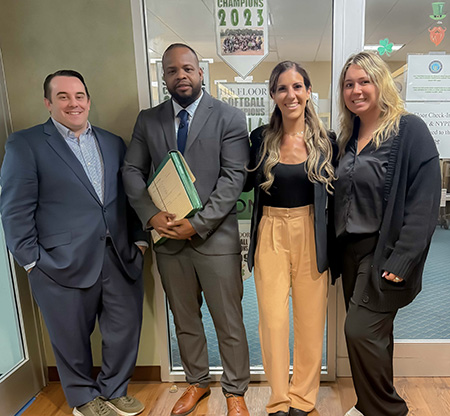 I joined the clinical program in the spring of 2025, during my 2L year. By mere chance, on the very last day applications were due, an upperclassman encouraged me to apply and explained how it fulfilled both my pro bono and experiential requirements. I originally applied for the Bankruptcy Clinic, but since I applied late, the spots were already filled. Soon after, I received an email offering placement in one of the remaining programs, including the Prosecution Clinic.
At first, I hesitated because the clinic required traveling to Brooklyn to the King’s County District Attorney’s Office. The commute was long, and between the travel time, the added expense, and the unfamiliarity with the area, it felt like a big leap. After talking with friends and family, my perspective shifted. My brother, in particular, said something that really resonated with me when I asked for his opinion. He said, “Don’t look at this like an expense because it’s not. It’s an investment.” That’s when it clicked for me. Instead of seeing those factors as deterrents, I began to view the experience as an investment in my future.
At the time, I was not sure whether I was meant to become a litigator. I knew I could argue, but the idea of doing it in a courtroom felt intimidating given the structure, expectations, and public speaking component. So, when I was given this opportunity, I realized it was my chance to find out whether this path was truly for me. Even though criminal law wasn’t initially my interest, the practical courtroom exposure made the clinic feel like a privilege I couldn’t walk away from. Looking back now, joining the clinic was one of the best decisions I made in law school. I unexpectedly loved the work, and the environment was energizing and meaningful. The prosecutors I worked with were nothing like the stereotype I had in mind; they were thoughtful, compassionate, and genuinely committed to justice.
Two prosecutors in particular shaped my experience in a profound way. The first was the attorney I shadowed most closely, Senior Assistant District Attorney (ADA) Carly Muth. She didn’t just let me observe, she included me. She walked me through procedures, explained strategy, and treated my questions with patience and respect. She encouraged me to speak on the record for the first time and later allowed me to sit second seat at a hearing, moments that were both intimidating and transformative. Watching her balance strength, clarity, and empathy in the courtroom was truly inspiring. It showed me what confident advocacy can look like, especially for young women in this field.
The second was Deputy Bureau Chief Michael Boykin, who also served as the clinic professor. He challenged my perspective from day one. From the outset, I was upfront that I had no desire to pursue criminal law, as I could not see myself in a profession focused on locking people up. Professor Boykin responded by introducing me to the philosophy of ‘progressive prosecution.’ At the time, I was admittedly unconvinced. However, as the semester progressed, I was able to really see first-hand what that looked like in practice. This office was not focused solely on punishment; rather it emphasized rehabilitation, opportunity, and improving community outcomes. Witnessing that approach reshaped my understanding of the criminal justice system and ultimately inspired the career path I now hope to continue pursuing.
What are your plans after graduation?
After graduation, I plan to take the July 2026 Bar Exam and continue pursuing a career in prosecution. My clinical experience confirmed that the courtroom is where I want to be, advocating, problem-solving, and serving the community.
What advice would you give to a prospective law student?
The best advice I would give to a prospective law student is to invest in yourself. Law school can feel overwhelming, and it’s easy to talk yourself out of opportunities because they seem intimidating, inconvenient, or outside your comfort zone. But those experiences, the ones that push you, are often the ones that shape you the most. Say yes instead of defaulting to no. Don’t let fear, uncertainty, or self-doubt make decisions for you.
These years go by quickly, and you don’t get them back. You’re allowed to be ambitious, curious, and even a little selfish during this time, because this investment is for your future. So, take the class that scares you, apply for the clinic, introduce yourself to the attorney at the event, and choose yourself and your growth every time. You’ll be grateful you did.
Back